


Cellavia · Personal nutrition profile
GenoNutra
Bring your nutrition in line with your biology.
- 10main groups
- 74topics
- 268SNP
- A personal plan with your dietitian
- Painless cheek swab
- Same sample as GenoMetabolics
What is it?
What suits everyone may not suit you
A food that is said to be healthy for everyone may not suit everyone in the same way. Nutrigenetics helps us understand why.
GenoNutra is a nutrigenetic analysis of the genetic tendencies linked to how you respond to foods and dietary patterns. By looking at digestion, metabolism and lifestyle together, it gives you and your dietitian the information to set your personal nutrition priorities.
 The preliminary consultation, interpretation of the report and follow-up are carried out by Cellavia's physicians and dietitians; laboratory analyses are performed by our partner GENOMEDİS.
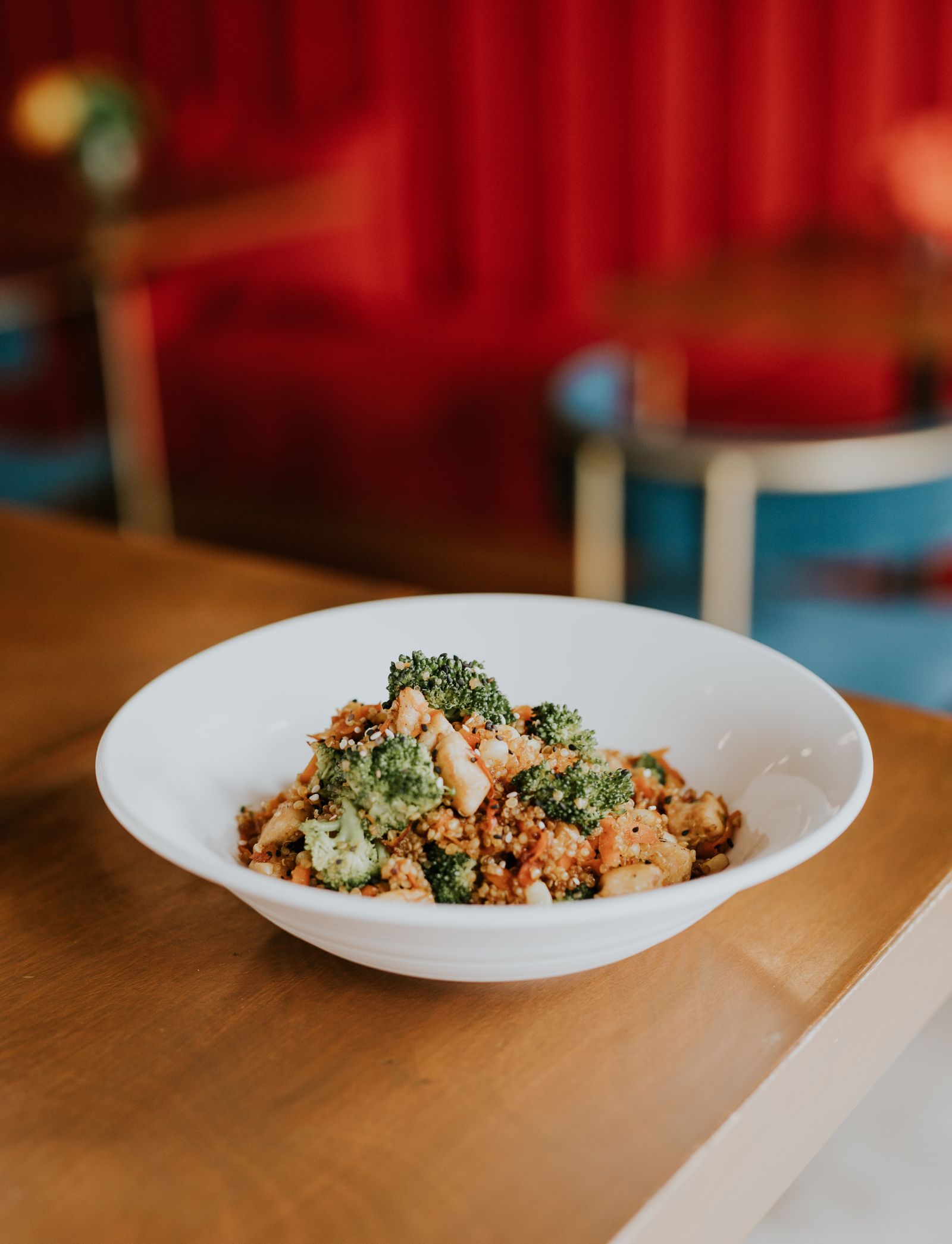
Made for your plate
It becomes clear which food groups to approach with more care and which may benefit you most.
A more sustainable plan
The same diet does not produce the same response in everyone. When genetic tendencies are assessed together with your habits, symptoms and measured values, your plan becomes more personal and more sustainable.
Micronutrients
Tendencies in your need for micronutrients such as vitamin D, B12, folate and iron are assessed together with laboratory values.
Did you know?
Genetics on your plate
The same plate does not produce the same response in everyone. A few examples:
Lactose
Whether the lactase enzyme persists into adulthood is largely linked to a variant in the MCM6/LCT region.
Coffee
How fast you break down caffeine depends largely on the CYP1A2 gene; in some people it is markedly slower.
Omega-3
The capacity to convert plant omega-3 into its active forms is linked to the FADS genes and varies from person to person.
Vitamin D
How vitamin D is transported in the blood and used in cells is linked to genes such as GC and VDR; it is assessed together with measured levels.
These examples are for general information; what they mean for you becomes clear through your report and physician consultation.
Scope
74 topics in 10 main groups
Each topic is assessed on its own; results are not added together or combined into a single total score.
Each segment of the ring is one main group; its size shows the number of topics in that group.
Nutritional responses by genetic make-up
16 topics
Digestion, food tolerance and food responses
8 topics
Blood sugar, insulin and energy balance
6 topics
Fat metabolism and cardiovascular health
7 topics
Vitamin, mineral and methylation pathways
12 topics
Detoxification and antioxidant defence
6 topics
Cellular energy, muscle and exercise response
5 topics
Immunity, inflammation and gut health
5 topics
Brain health, stress and sleep
8 topics
Specific clinical findings and drug responses
1 topic
The language of genetics
Single-letter differences, personal responses
- DNA
- The molecule that carries the information cells need to build and run themselves, written in the letters A, T, G and C.
- SNP
- A single-letter difference at a specific position in the DNA that can vary from person to person.
- Allele
- One of the letter forms that can occur at the same position – for example A or G.
- Genotype
- The combination of the two alleles you carry at a position – one inherited from your mother, one from your father.
- AANot a carrierNo effect allele
- AGHeterozygousOne copy
- GGHomozygousTwo copies

Your plate is the closest daily contact you have with your genes.
The Cellavia approach
Process
Your genetic map in four steps
You give your sample in a single appointment; our team and laboratory take care of the rest.
- 01
Initial consultation
Your physician listens to your medical history and expectations; together you decide whether the test is right for you, and your consent is obtained.
- 02
Sampling
A painless swab taken from inside the cheek in a few minutes. Please do not eat, drink or smoke for 30 minutes beforehand.
- 03
Laboratory analysis
The genetic material is analysed on a microarray-based platform that reads hundreds of thousands of positions at once; results are interpreted using scientific algorithms.
- 04
Report and consultation
Your personal report is talked through in plain language during your physician consultation and translated into your programme.



Report
How to read your report
Key findings are summarised under three headings at the start of the report. Each topic page shows the genetic effect score, the direction of effect and the variants examined.
Priority findings
Topics with a marked genetic effect that are recommended as a first focus of your nutrition plan.
Monitoring plan
Topics recommended for follow-up with measurements at regular intervals.
Protective areas
Topics where your genes point in a relatively protective direction, highlighting your strengths.
Genetic effect score
For each topic, the ratio of effect alleles to the maximum possible value is expressed as a score from 0 to 100. The score is meaningful only within its own topic and is not compared across topics.
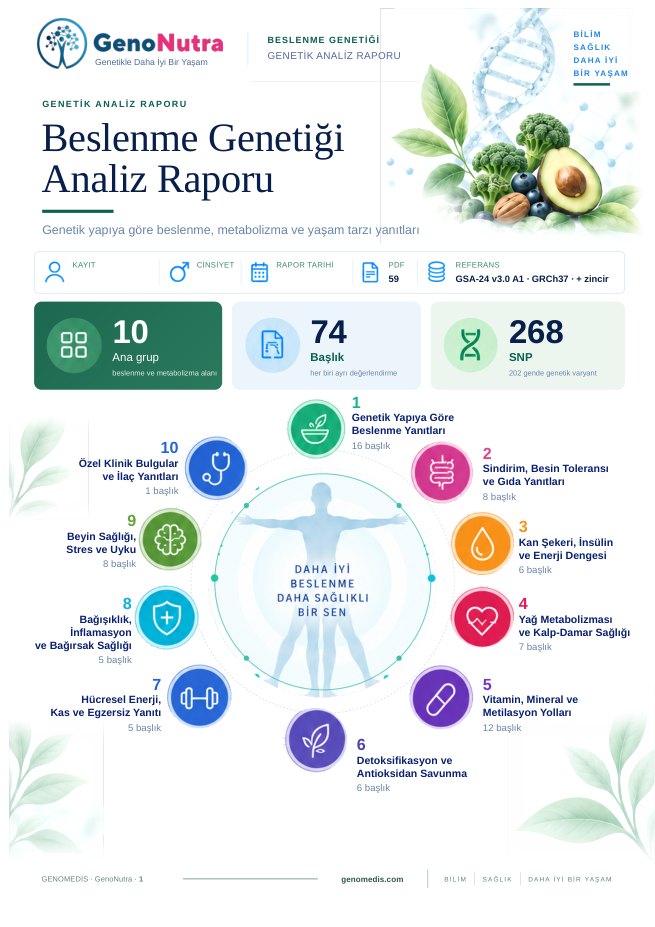
Sample report
Add personal data to your nutrition plan
The report includes key findings, the direction of genetic effect, nutrition and lifestyle assessments, and biomarkers that can be followed up. Scores are interpreted only within their own topic.
- 10 main groups, 74 topics and 268 SNPs
- Genetic effect score and direction of effect for each topic
- Nutrition and lifestyle assessments
- Biomarkers to follow up
After the report
How do the results become a programme?
The report is a starting point. Its value comes when your physician and dietitian help you bring it into everyday life.
Dietitian consultation
Your findings are discussed alongside your eating habits and goals.
Personal nutrition protocol
Macronutrient balance, meal timing and food choices are planned around your genetic tendencies.
Checked by measurement
Where needed, values such as vitamins, minerals and blood lipids are measured in the laboratory to fine-tune the plan.
Follow-up
The effect of the plan on your body is tracked through follow-up appointments and repeat measurements.
Plan your nutrition around your genetics
At Cellavia, GenoNutra begins with a preliminary consultation; your results are turned into a personal nutrition plan with your physician and dietitian.
Comparison
Which analysis is right for you?
The two analyses complement each other. Whether to plan one or both is decided after your physician assessment.
| GenoMetabolics | GenoNutra | |
|---|---|---|
| Focus | Metabolic pathways and related biological processes | Responses to nutrition, metabolism and lifestyle |
| Scope | 19 pathways · 137 sections · 621 SNPs | 10 main groups · 74 topics · 268 SNPs in 202 genes |
| Key areas | Cardiovascular system, hormones, pharmacogenetics, clinical genetics | Carbohydrate and fat response, food tolerance, vitamins, caffeine |
| Who it is for | People who want to see the full picture of their health | People who want to plan their diet around their genetic make-up |
| Sample type | Cheek swab | Can be run on the same sample |

Healthy Living Retreat
Genetic analysis at the retreat
GenoNutra is included, together with GenoMetabolics, in the 15-day Comprehensive Biological Transformation Retreat. Results are discussed in the second half of the programme, and from then on the kitchen switches to personalised meals.
- 10 daysAdvanced Reset RetreatGenoMetabolics
- 15 daysComprehensive Biological Transformation RetreatGenoMetabolics + GenoNutra
Frequently asked questions
What people ask
Will GenoNutra give me a diet plan?
The report is not a diet plan; it shows your genetic tendencies. Your dietitian combines these findings with your medical history and laboratory results to create a personal nutrition protocol.
What does a high score on a topic mean?
A high score means the genetic effect in that topic is marked; it does not mean there is a problem. What it means depends on the topic, and it is always interpreted by a specialist.
Should I take supplements based on my results?
Decisions about supplements are never based on genetics alone. Where needed, your blood levels are measured, and your physician and dietitian decide together.
Is a lactose or gluten result an allergy diagnosis?
No. These topics show genetic predisposition only; conditions such as food intolerance or coeliac disease are diagnosed through clinical assessment and laboratory tests.
Can I have it done together with GenoMetabolics?
Yes. Both analyses can be run on the same cheek swab, and together they give a more complete picture.
How is GenoNutra used at the retreat?
In the 15-day retreat, results are discussed in the second half of the programme. From that day on, the kitchen prepares each participant's meals in line with their own nutrigenetic profile.
Limits of the results
Genetic analysis does not diagnose and does not recommend treatment. A tendency does not mean a trait will necessarily develop; nutrition, lifestyle, environment and overall health also shape the outcome. Findings do not replace measured biomarkers and are always interpreted together with your medical history, examination and laboratory results. Genetic tendencies are neither a diagnosis nor a diet prescription on their own; results are interpreted together with clinical data.
Your genetic data and privacy
Genetic data is personal and sensitive. Your results are shared only with you and, with your consent, with your care team, and are stored in line with data protection law.
Consultation
Begin Your Personal Longevity Journey
To decide on the right protocol for you, let us review your medical history, your cellular status and your health goals together with our specialist physicians. Contact our team to arrange your first consultation.