

Cellavia · Metabolic pathway profile
GenoMetabolics
A personal roadmap of your biology.
- 19metabolic pathways
- 137sections
- 621SNP
- A one-time test
- Painless cheek swab
- Results reviewed with your physician
What is it?
Same lifestyle, different responses
Two people who eat the same meals and go to bed at the same time can respond quite differently. Part of that difference lies in tiny variations in the genes that govern metabolism.
GenoMetabolics is a holistic analysis that evaluates selected genetic variants within metabolic pathways and related biological systems. It looks at the links between nutrition, energy, hormones and cellular processes together with your individual genetic tendencies.
 The preliminary consultation, interpretation of the report and follow-up are carried out by Cellavia's physicians and dietitians; laboratory analyses are performed by our partner GENOMEDİS.

Unique to you
Rather than general advice, a roadmap based on how your body tends to work.
Shows the connections
Metabolism works as a network. Looking at related processes together rather than one gene at a time makes clear which areas to prioritise in monitoring, nutrition or lifestyle planning.
Works with measurement
Genetic tendencies become meaningful when combined with blood tests, telomere and epigenetic measurements.
Did you know?
Your genes in everyday life
Genetic differences often show up in everyday life without us noticing. A few examples:
Coffee
How fast you break down caffeine depends largely on the CYP1A2 gene; in some people it is markedly slower.
Alcohol
Facial flushing after alcohol may be linked to a common variant in the ALDH2 gene.
Folate
A common variation in the MTHFR gene can affect how quickly folate is converted to its active form.
Medicines
Differences in enzymes such as CYP2C19 can change how some medicines are processed in the body.
These examples are for general information; what they mean for you becomes clear through your report and physician consultation.
Scope
Your metabolism mapped across 19 pathways
Each pathway is assessed with its own algorithm, according to its biology and the scientific evidence. The pathways fall into six main areas.
- Nutrition, digestion and methylation6
- Energy and cellular defence3
- Hormones, brain and biological rhythm3
- Heart, immunity and movement4
- Cellular ageing and repair1
- Clinical targets and pharmacogenetics2
Nutrition, digestion and methylation
Gut barrier; vitamin–mineral, folate and one-carbon pathways; glucose, fat, appetite and energy balance.
- 06Digestion, gut barrier and food-related traits
- 07Vitamin and mineral metabolism
- 08One-carbon metabolism, folate and the methylation cycle
- 01Glucose metabolism and insulin balance
- 02Fat and cholesterol metabolism
- 03Appetite, body weight and energy expenditure
Energy and cellular defence
Amino acid and glutathione precursors; mitochondrial energy, antioxidant defence, xenobiotic and alcohol metabolism.
- 09Amino acid and glutathione precursor pathways
- 05Mitochondrial energy production and antioxidant defence
- 17Xenobiotic and alcohol metabolism
Hormones, brain and biological rhythm
Processes linked to the thyroid, reproductive hormones, neurotransmitters, stress response, sleep and circadian rhythm.
- 04Thyroid hormone metabolism and metabolic regulation
- 13Hormonal balance and reproductive health
- 14Neurotransmitters, stress response and biological rhythm
Heart, immunity and movement
Cardiovascular pathways, inflammation, immunity, muscle and exercise response, bone and connective tissue health.
- 10Cardiovascular system
- 15Inflammation and immune response
- 12Muscle and exercise performance
- 11Bone and connective tissue health
Cellular ageing and repair
Selected variants linked to DNA repair, epigenetic regulation and telomere biology.
- 16Cellular ageing, DNA repair and telomere biology
Clinical targets and pharmacogenetics
Limited hereditary cancer target variants and a drug response guide; clinical confirmation requirements.
- 19Clinical genetics: targeted hereditary cancer variants
- 18Pharmacogenetics and drug response guide
Cellavia Metabolic Atlas
Your genes on the pathway map
See at a glance where your genetic findings sit in your metabolism. The atlas is a simplified map of the 19 metabolic pathways in the report; you review your own results with your physician in the results consultation.
- 19 pathways, one map
- Search by gene or RSID
- 7-step guided tour
- Full screen and mobile-friendly
Pathways / Overview
67 genes · 66 variants · 19 pathways
Tap a section to zoom in
To zoom, scroll while holding Ctrl (⌘), or open full screen
Metabolic Atlas
Explore your body's chemistry map in 7 steps
The map is for information only; the selection of genes and variants is illustrative and contains no personal results. Drag to move around, and after clicking on the map use the scroll wheel to zoom.
Sources
- Metabolic pathways: Nicholson DE. Metabolic Pathways, 22nd edition. International Union of Biochemistry and Molecular Biology (IUBMB) and Sigma-Aldrich, 2003. The map has been simplified and redrawn by Cellavia on the basis of this source; it is not a copy of the original poster.
- Enzyme numbers: IUBMB Enzyme Commission (EC) classification.
- Gene names and variant IDs (RSID): HGNC gene nomenclature and the NCBI dbSNP database.
The language of genetics
Single-letter differences, personal responses
- DNA
- The molecule that carries the information cells need to build and run themselves, written in the letters A, T, G and C.
- SNP
- A single-letter difference at a specific position in the DNA that can vary from person to person.
- Allele
- One of the letter forms that can occur at the same position – for example A or G.
- Genotype
- The combination of the two alleles you carry at a position – one inherited from your mother, one from your father.
- AANot a carrierNo effect allele
- AGHeterozygousOne copy
- GGHomozygousTwo copies

Genes are not destiny; they are your body's user manual.
The Cellavia approach
Process
Your genetic map in four steps
You give your sample in a single appointment; our team and laboratory take care of the rest.
- 01
Initial consultation
Your physician listens to your medical history and expectations; together you decide whether the test is right for you, and your consent is obtained.
- 02
Sampling
A painless swab taken from inside the cheek in a few minutes. Please do not eat, drink or smoke for 30 minutes beforehand.
- 03
Laboratory analysis
The genetic material is analysed on a microarray-based platform that reads hundreds of thousands of positions at once; results are interpreted using scientific algorithms.
- 04
Report and consultation
Your personal report is talked through in plain language during your physician consultation and translated into your programme.



Report
How to read your report
The report opens with a summary of key findings, selected from all results and grouped under three headings. Each section is then set out in detail: the genes involved, your genotype and what the finding means.
Priority review
Findings recommended as a first focus of your physician assessment, supported by further tests where needed.
Planned action
Findings that can be addressed step by step through changes to nutrition, movement and lifestyle.
Favourable signals
Findings that point in a relatively protective or favourable direction, highlighting your strengths.
Examples of topics covered in the report: salt sensitivity and blood pressure tendency · insulin signalling and sensitivity · triglyceride metabolism · bone density · folate and B12 cycle · drug-metabolising enzymes
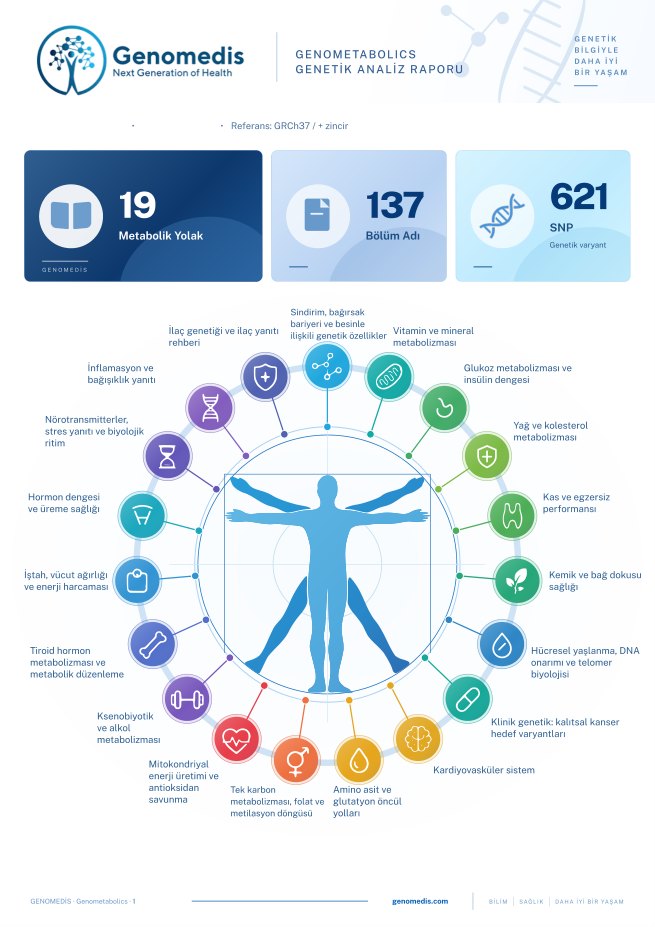
Sample report
From genetic findings to personal priorities
The report explains your genotype, the finding category and the genetic effect. For the relevant topics, it sets out biomarkers that can be monitored, as well as nutrition, lifestyle and condition-specific supplement assessments.
- 19 metabolic pathways, 137 sections and 621 SNPs
- Genotype, finding category and genetic effect for each section
- Biomarkers that can be monitored
- Nutrition, lifestyle and condition-specific supplement assessments
After the report
How do the results become a programme?
The report is a starting point. Its value comes when your physician and dietitian help you bring it into everyday life.
Physician assessment
Priority findings are reviewed alongside your medical history and laboratory results; further tests are arranged if needed.
Nutrition protocol
Your dietitian draws up a nutrition plan suited to your metabolic tendencies.
Movement and recovery
Type and intensity of exercise and recovery time are tailored to your muscle and energy findings.
Ongoing monitoring
How your genetic tendencies play out in daily life is tracked through repeat measurements.
Read your report with your physician
At Cellavia, GenoMetabolics begins with a preliminary consultation and ends with a meeting in which your results are reviewed with your physician.
Comparison
Which analysis is right for you?
The two analyses complement each other. Whether to plan one or both is decided after your physician assessment.
| GenoMetabolics | GenoNutra | |
|---|---|---|
| Focus | Metabolic pathways and related biological processes | Responses to nutrition, metabolism and lifestyle |
| Scope | 19 pathways · 137 sections · 621 SNPs | 10 main groups · 74 topics · 268 SNPs in 202 genes |
| Key areas | Cardiovascular system, hormones, pharmacogenetics, clinical genetics | Carbohydrate and fat response, food tolerance, vitamins, caffeine |
| Who it is for | People who want to see the full picture of their health | People who want to plan their diet around their genetic make-up |
| Sample type | Cheek swab | Can be run on the same sample |

Healthy Living Retreat
Genetic analysis at the retreat
GenoMetabolics is included in the 10-day Advanced Reset Retreat and the 15-day Comprehensive Biological Transformation Retreat. The sample is taken on day one, and our physicians present the report in a one-to-one consultation.
- 10 daysAdvanced Reset RetreatGenoMetabolics
- 15 daysComprehensive Biological Transformation RetreatGenoMetabolics + GenoNutra
Frequently asked questions
What people ask
Does GenoMetabolics diagnose disease?
No. The analysis shows tendencies based on the genetic variations examined; it does not diagnose or recommend treatment. Your physician assesses the results together with your medical history and laboratory results.
Will I need to repeat the test?
Your genetic code does not change over your lifetime, so the analysis only needs to be done once. What changes is how this information shows up in your lifestyle, and we track that with blood tests, epigenetic testing and other measurements.
Is a blood sample needed?
No. The sample is a painless swab taken from inside the cheek in a few minutes.
What if the report shows a hereditary risk?
If there is a finding of possible clinical significance, your physician will discuss it with you in person. Where appropriate, you will be referred to the relevant specialist for confirmatory testing and genetic counselling.
Can I change my medication based on the pharmacogenetics section?
No. Drug-response findings are for information only; the dose or use of any medicine you take can only be changed by the physician who prescribed it. We recommend sharing your report with them.
How do GenoMetabolics and GenoNutra differ?
GenoMetabolics looks at the full picture of your metabolism, while GenoNutra goes into detail on your responses to nutrition. Both can be run on the same sample.
Limits of the results
Genetic analysis does not diagnose and does not recommend treatment. A tendency does not mean a trait will necessarily develop; nutrition, lifestyle, environment and overall health also shape the outcome. Findings do not replace measured biomarkers and are always interpreted together with your medical history, examination and laboratory results. Clinical target screening is limited; a negative finding does not rule out disease. The scope reflects the sample report version.
Your genetic data and privacy
Genetic data is personal and sensitive. Your results are shared only with you and, with your consent, with your care team, and are stored in line with data protection law.
Consultation
Begin Your Personal Longevity Journey
To decide on the right protocol for you, let us review your medical history, your cellular status and your health goals together with our specialist physicians. Contact our team to arrange your first consultation.