

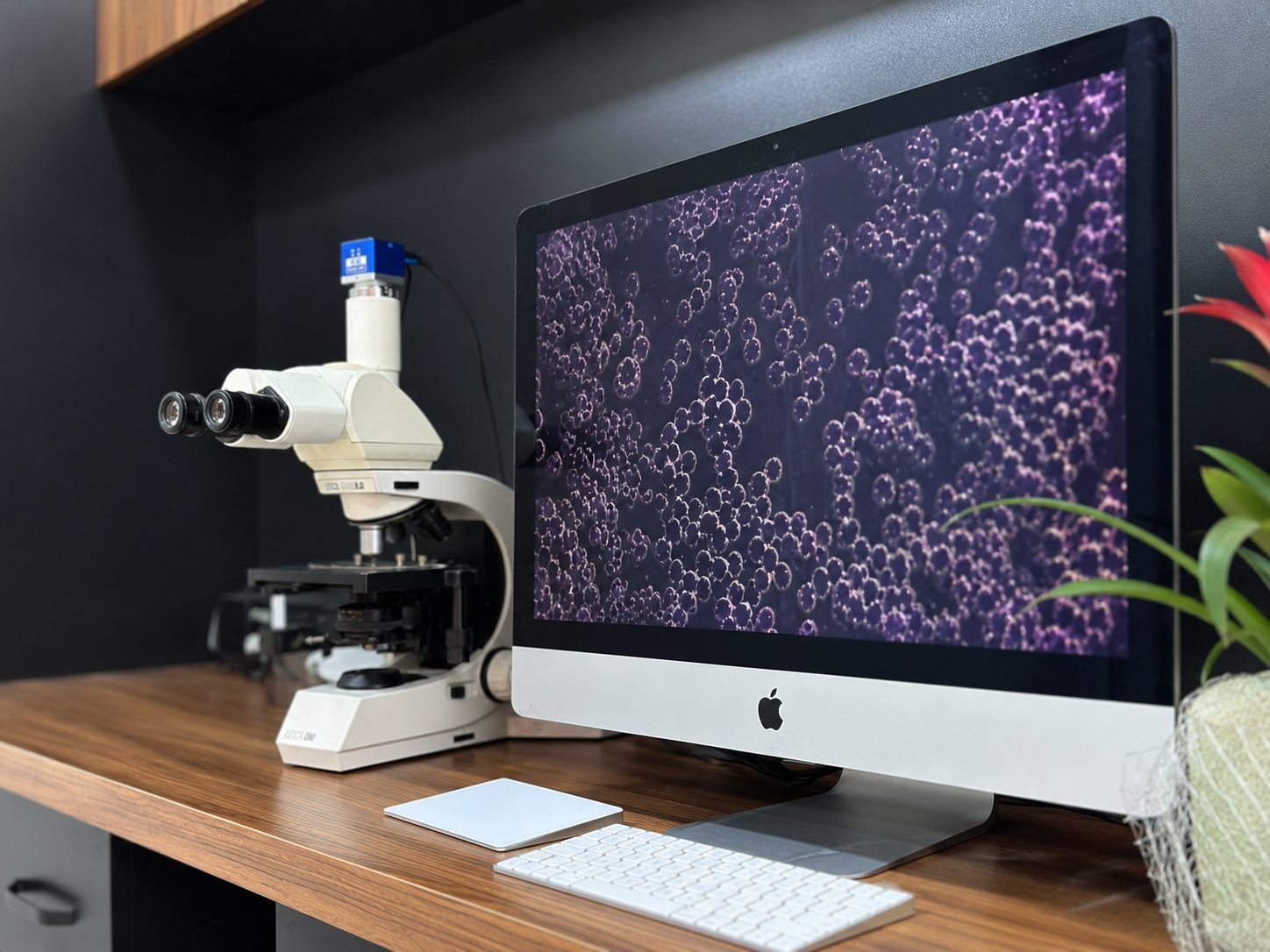
Standard blood tests are like a country’s census: how many people are there, and are the numbers normal? Dark-field microscopy is a live satellite image of that country.
What is it?
Dark-field microscopy uses a special illumination technique in which light reaches the sample from the side. This makes living cells stand out brightly against a dark background. A single drop of blood taken from the fingertip is examined in its living state, without staining or any chemical processing.
This method makes it possible to observe not only what the blood contains, but also how the cells relate to one another and what their surrounding environment looks like.
What is observed?
- Red blood cells. The shape and size of the cells and whether they stick together.
- White blood cells. The appearance and mobility of the cells.
- Plasma. The general appearance of the fluid in which the cells float.
How is it done?
A single drop of blood is taken from the fingertip with a sterile lancet and placed immediately on a slide. The examination takes a few minutes. The images are projected onto a screen, and your physician explains what they see together with you.
How is it interpreted?
Dark-field microscopy is not a diagnostic method and is not used to diagnose any disease. We do not assess its results on their own, but as part of a holistic picture together with your laboratory tests, your physician’s assessment and your other measurements. Repeated at the end of the programme, it helps to observe the change.
Which programmes include it?
Following a physician’s assessment, this measurement can be planned as needed as part of the longevity assessment and the one-month programmes.
Other measurement methods
- DNA analysis. A personal guide showing your genetic tendencies relating to nutrition, exercise and metabolism. Explore
- Telomere measurement. Measurement of telomere length, one of the researched markers of cellular ageing. Explore
- Epigenetic test. Shows how your lifestyle is reflected in the way your genes work, together with biological age markers. Explore
- FRAS 5 oxidative stress measurement. Measurement of the balance between free-radical load and antioxidant defence. Explore
- OligoScan. A needle-free mineral and heavy-metal screening taken from the palm of the hand in a few minutes. Explore
- Biothermology. Assessment of the thermoregulatory response by mapping heat distribution across the body. Explore
- Spiroergometry. Determining personalised training zones by measuring oxygen use during exercise. Explore
Frequently asked questions
How long does dark-field microscopy take?
About 60 minutes. The exact duration is planned by our team according to your assessment and programme.
When and how are the results of dark-field microscopy reviewed?
On the same day, together on screen. Your results are always reviewed with a specialist physician, in clear and understandable language.
Is any preparation needed for dark-field microscopy?
None. We send you the necessary preparation instructions before your appointment.
Who is dark-field microscopy not suitable for?
Eligibility is always determined by a physician’s assessment. In conditions such as pregnancy, cardiovascular disease and uncontrolled chronic illness, some applications are not performed or require a physician’s approval.